A client checks their Google rankings and everything looks fine. Page one for their main keywords, steady traffic, nothing alarming in the dashboard.
Then someone mentions that when they asked ChatGPT the exact same question their business answers every day, their name never came up. A competitor’s did.
That’s not a fluke, and it’s not a sign the SEO work was done wrong. It’s a sign that ranking well on Google and being visible in AI search have quietly become two different jobs.
For years they were basically the same job. They aren’t anymore, and that gap is what hybrid SEO is actually about.
What Hybrid SEO Actually Means
Hybrid SEO isn’t a replacement for traditional SEO, and it isn’t a rebrand of it either.
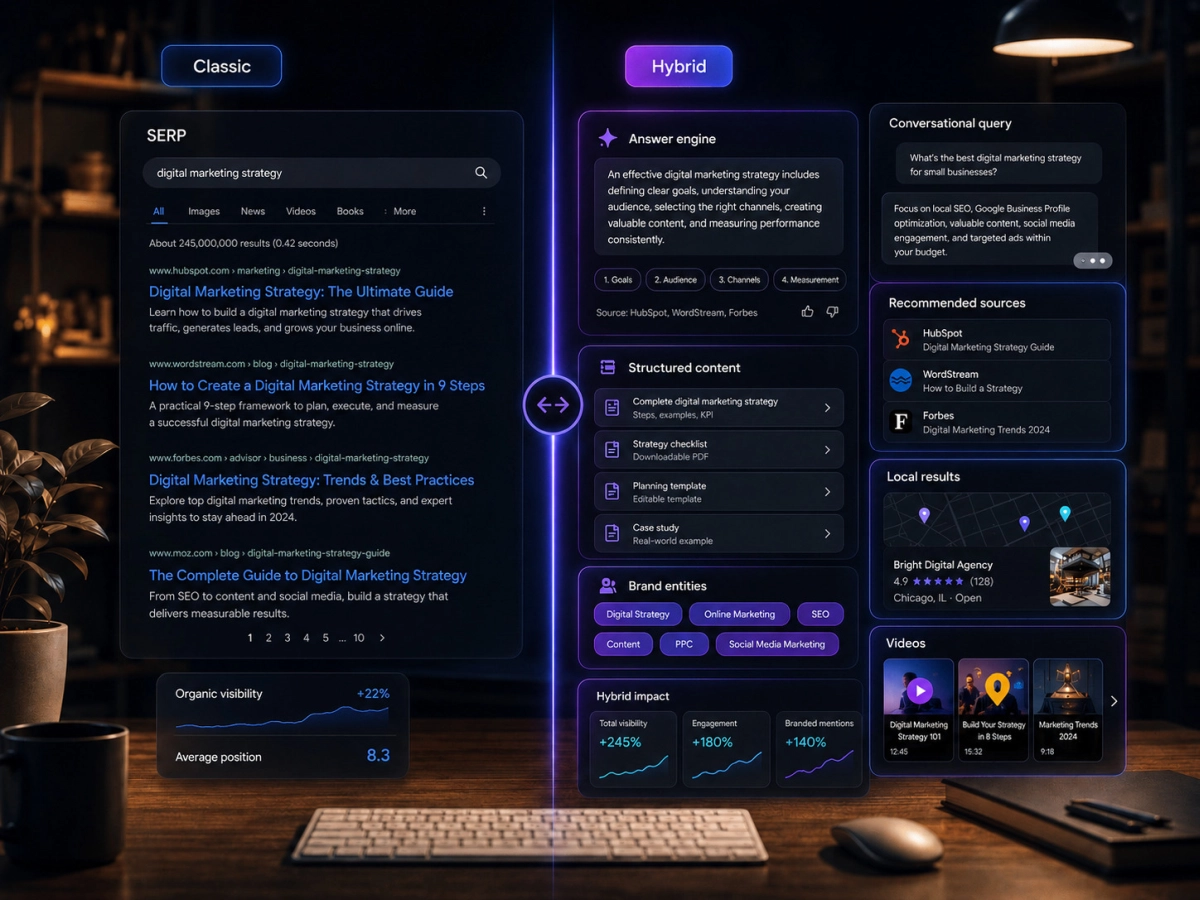
It’s the recognition that a person looking for information today might type a query into Google, ask Perplexity a full question, or get an answer synthesized by ChatGPT, sometimes all in the same afternoon.
Each of these systems selects and presents information differently. Being visible in one doesn’t guarantee visibility in another.
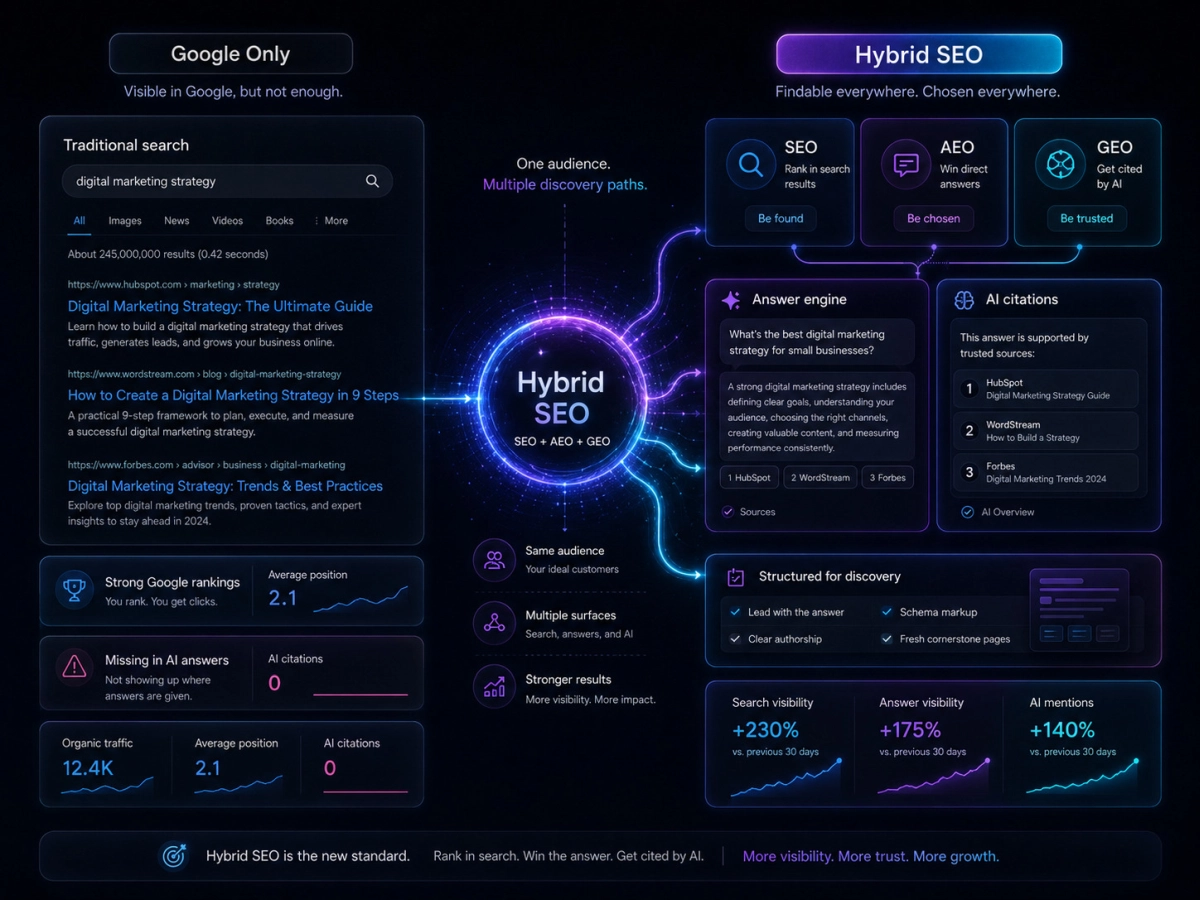
SEO, AEO, and GEO Are Three Different Goals
Traditional SEO still does what it always did. It helps a page rank in a list of search results, competing for a click.
Answer engine optimization (AEO) sits on top of that. It structures content so it can be lifted out and shown directly as the answer, in a featured snippet or a voice response, without anyone clicking through.
Generative engine optimization (GEO) goes further. It’s not about winning a spot in a list, it’s about being one of the sources an AI model pulls from when it writes its own answer, sometimes naming you, sometimes not.
Hybrid SEO means running all three at once, because your actual audience doesn’t pick a lane between them.
Why Google Rankings Alone No Longer Guarantee Visibility
For most of the last two decades, ranking well on Google was close enough to the whole strategy. If a page ranked, it got clicked, and that was the outcome that mattered.
That relationship is breaking down. Not because Google is disappearing, but because a growing share of searches now get resolved without a click at all.
Google answers the question directly, or the person asked an AI assistant instead of opening a browser tab in the first place.
That shift changes what visibility even means. A page can sit comfortably on page one and still be functionally invisible to a large, growing slice of the audience.
That’s the slice that never sees a results page, because their question got answered somewhere else entirely.
Why AI Systems Skip Pages That Rank Well on Google
AI systems don’t evaluate a page the way Google’s classic ranking algorithm does. They don’t just decide whether a page deserves to rank.
They read through a page looking for a specific, extractable answer to a specific question.
A page written the way “good SEO” trained everyone to write for the last fifteen years works against that: an introduction that delays the point, a keyword worked into every other sentence, a structure built to keep someone scrolling.
It reads like it was written to satisfy a ranking algorithm, not to actually answer the question. Some of the pages best optimized for old-school Google ranking are the ones AI systems are least likely to cite.
How to Structure Content So AI Search Can Actually Use It
None of this means throwing out solid SEO fundamentals. Technical health, site structure, and topical authority are still the foundation everything else sits on.
What changes is what gets built on top of that foundation.
Lead With the Answer, Not the Build-Up
Old SEO habit says build up to the answer, keep the reader engaged, save the payoff. AI extraction rewards the opposite.
State the direct answer plainly, near the top of the relevant section, then explain it.
A page can still have personality and depth further down. But if the core answer isn’t clear and early, an AI system has no clean passage to lift out and cite.
Make It Obvious Who’s Actually Saying It
Source credibility matters more than it used to. AI models weigh who’s behind the content heavily when deciding what to trust.
That credibility increasingly comes from consistent, verifiable signals: a real author bio, a company identifiable across LinkedIn, its own site, and other credible platforms.
A page with no clear author and no verifiable identity behind it is a much weaker citation candidate, even if the writing itself is just as good.
Use Schema Markup as a Translation Layer, Not a Decoration
Structured data plays a bigger role here than most businesses treat it.
Schema markup used to be a nice-to-have, a way to earn a slightly better-looking snippet.
Now it’s closer to a translation layer. It’s how a crawler or a model understands what a page is, who wrote it, and what question it answers.
Keep Cornerstone Pages Fresh
Freshness matters more than it once did. AI systems appear to weight how recently a page was updated when deciding which sources to trust for a given question.
A strong page written two years ago and never touched since is quietly losing ground to competitors who keep revisiting theirs.
Why Hybrid SEO Needs Ongoing Work, Not a One-Time Fix
The instinct with anything labeled “optimization” is to treat it as a project with an end date: audit the site, fix the issues, move on.
Hybrid SEO doesn’t work that way, and pretending it does is one of the more expensive mistakes a business can make right now.
Which sources an AI model cites for a given question isn’t fixed the way a Google ranking is. It shifts from one month to the next as models get updated and as competing content changes.
A business cited by ChatGPT this quarter has no guarantee of still being cited next quarter, and there’s no dashboard that reliably tells you when that changes.
The only real defense is treating this as ongoing maintenance, not a one-time fix.
A Practical Example: Fixing a Services Page for AI Search
Take a typical services page, ranking respectably on Google, written the conventional way: an engaging opening, a description of the business’s approach, a list of benefits, a call to action near the bottom.
It can do a perfectly good job of converting a human visitor who scrolls through it.
It can still contain almost nothing an AI system could lift out cleanly, because the actual answers, what does this cost, how does the process work, how long does it take, are buried inside persuasive paragraphs instead of stated plainly.
The fix usually isn’t a rewrite from scratch. It’s adding direct-answer passages inside the structure that’s already there.
A few sentences per section that state the core fact plainly, before the persuasive version continues, so both the human reader and an AI system scanning the page get what they need.
Ranking on Google and getting cited by an AI model are two different games now, running at the same time.
A page can win one while quietly losing the other, and nobody notices until a client points it out.
The businesses that stay visible from here on are the ones that stop assuming those two games are the same thing.
Frequently Asked Questions (FAQ)
Does hybrid SEO require different tools than traditional SEO?
Most foundational tools still apply, rank trackers, technical audits, and so on. Visibility into AI citations is a newer, less mature category. Right now most teams end up manually testing prompts across ChatGPT, Perplexity, and Google AI Overviews, since no unified analytics standard exists yet the way it does for organic search.
How long does it take to see results from AEO and GEO efforts?
Sometimes faster than traditional SEO, since AI citation doesn’t depend on the same slow accumulation of backlinks and domain authority. It’s also far less stable. A page can get cited within weeks of being restructured and lose that citation a month later, so results here means an ongoing trend to track, not a one-time milestone.
Can a small business realistically compete for AI citations against larger, more established brands?
Yes, more realistically than in traditional Google rankings, in some ways. AI citation tends to favor a clear, specific, well-structured answer over sheer domain authority. A smaller site that answers a narrow question precisely can out-cite a larger competitor’s vaguer page on the same topic.